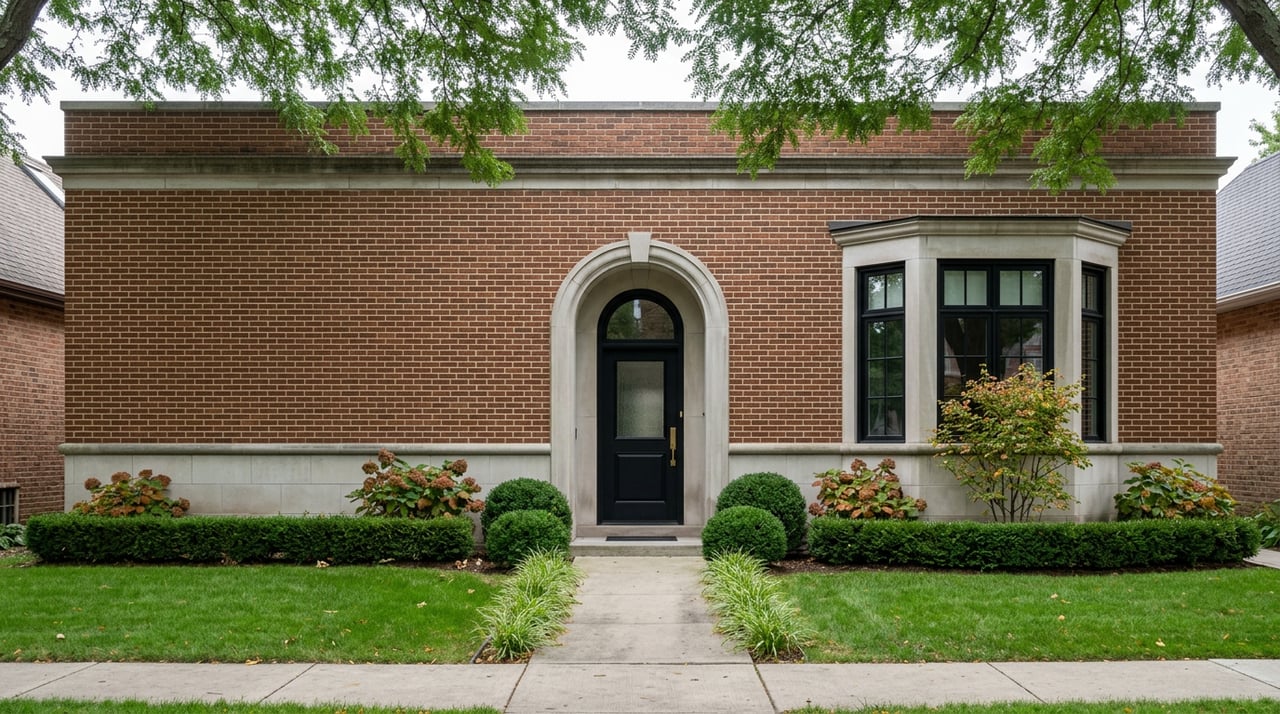
On a Sunday afternoon in late September, the fieldhouse at Promontory Point still throws its long shadow across the meadow the way it has since 1937. A few open water swimmers cut across the north bay before the water turns too cold to enjoy. Two blocks west, sound techs are running cable across the Midway Plaisance, testing microphones for a stage that will host jazz musicians from around the country in a matter of days. Nobody walking past either scene this year would guess they're watching the same story unfold twice.
The Hyde Park Jazz Festival turns 20 this September 26 and 27. The limestone revetment at Promontory Point turns roughly 89, and depending on which government timeline holds, it may not see its 90th birthday intact. Both facts are true at the same time, in the same half mile of lakefront, and neither one is really about nostalgia. They're both about a neighborhood learning, again, how much of what feels permanent here is actually on borrowed time.
Twenty Years of Festival, Nearly Ninety of Stone
The Hyde Park Jazz Festival started in 2007 as a free, neighborhood-scaled alternative to the ticketed festivals downtown, and it has grown without losing that character. This year's 20th anniversary lineup runs Saturday from noon to 10 p.m. and Sunday from 1 to 7 p.m., spread across the Midway Plaisance and indoor venues including Rockefeller Chapel, the Logan Center, and the Smart Museum. The anniversary bill includes a specially assembled HPJF 20th Anniversary Band featuring Hill, McCraven, Paul, and Ross, along with sets from the Alfredo Rodriguez Quintet featuring Pedrito Martinez, the Ari Brown Quintet, Amir ElSaffar's New Quartet, and Ben LaMar Gay. Admission is free, with a suggested ten dollar donation at the door.
The limestone under the Point tells a longer version of the same story. The Works Progress Administration funded its construction between 1937 and 1941, using relief labor to lay the stair-step blocks that still define the peninsula's edge. It is, at this point, the last stretch of that original 1930s limestone treatment left on Chicago's shoreline. Everywhere else, the city replaced it with concrete decades ago, mostly during a wave of shoreline hardening in the 1990s that the Illinois Historic Preservation Agency eventually halted, sparing only Promontory Point and a short section at Diversey-Wellington.
That's not a preservation footnote. It's the reason the Point still feels different from every other stretch of lakefront in the city, and it's the reason its future is still unsettled almost 25 years after the fight over it first started.
What the Army Corps Actually Said
The current status, as of a July 2026 feature from WBEZ's architecture desk, is that the U.S. Army Corps of Engineers' latest plan calls for closing Promontory Point for three to five years beginning in 2027, to replace the historic revetment. Jack Spicer, a retired landscape architect and president of the Promontory Point Conservancy, put the disagreement plainly to WBEZ: "Concrete revetments make it feel like there's a war going on between the lake and the city. But the limestone steps make it look like, oh no, these two things, the lake and the city, belong together."
The engineering picture is more forgiving than a demolition timeline suggests. A structural assessment from McLaren Engineering Group, commissioned by the Conservancy and covered in reporting by the Chicago Maroon, found that the revetment's most damaged sections show only about 25 percent considerable deterioration, and most of that is cosmetic rather than structural. McLaren's own estimate is that the number of blocks actually requiring replacement runs into the dozens, not the hundreds. A separate historic structure report from Wiss, Janney, Elstner Associates, completed in January 2025, reached a similar conclusion: the existing limestone still functions largely as designed and can be repaired under standard federal preservation guidelines rather than torn out.
Here's the part that matters if you live within walking distance of the Point rather than reading about it from City Hall. A three to five year closure isn't a construction inconvenience you route around. It's several consecutive summers without the north bay swimming area, without the council-ring fire pits, without the casual sunset walk that ends at the fieldhouse. The Conservancy and half a dozen preservation groups, including Landmarks Illinois and the National Trust for Historic Preservation, have spent the past two years pushing back on the scope of the plan precisely because the gap between "repair" and "close it down for half a decade" is enormous, and nobody currently using the Point gets a vote on which version the Corps ultimately builds.
None of this means the bulldozers show up next spring. Timelines on this project have slipped for over two decades, and the current 2027 start date could move again. But it's the first time in years the date has been specific enough to plan around, which is a different kind of urgency than the vague "someday" that's hung over this fight since 2001.
The Corridor Around It Isn't Waiting
While the Point's future gets argued over in federal consulting-party meetings, 53rd Street has kept doing what it always does, which is turn over restaurants at a pace most Chicago commercial strips would envy.
14 Parish Restaurant & Rhum Bar opened between Hyde Park Boulevard and Cornell, bringing Caribbean fusion cooking and a bar stocked with more than 100 rums to a stretch of 53rd that didn't have anything quite like it before. Weekend brunch runs Saturday and Sunday from 10 a.m. to 3 p.m., and the happy hour window Tuesday through Thursday from 3 to 6 p.m. has become a fixture for the after-work crowd. A few doors down, Strings Ramen Hyde Park, part of a small local chain with locations in Chinatown and Lakeview, gives the corridor a ramen-only kitchen where most competitors treat noodles as a side note to a broader menu. Cedars Mediterranean Kitchen, further along at 1206 E. 53rd, keeps doing steady business in a category the street was arguably missing for years.
The neighborhood's restaurant density showed up on a bigger stage too. When Choose Chicago announced its 19th annual Chicago Restaurant Week for January 23 through February 8, 2026, eight Hyde Park restaurants made the list, several for the first time, including BarDavid, Chemistry, Dawn, Mahari, Nando's Peri-Peri, and Virtue. That's not a small showing for a neighborhood this size, and it's a sign that whatever happens to the shoreline in 2027, the commercial strip six blocks inland isn't waiting around for a resolution.
A Weekend That Won't Repeat Itself
If you already live in Hyde Park, the practical version of all this is simple. This year's Jazz Festival weekend is worth building an actual plan around, not just a maybe.
- Saturday, September 26: Arrive early for daytime sets on the Midway Plaisance, then walk the eight or so blocks to the Point before dusk. The swimming season is close to over, but the light off the fieldhouse in late September is some of the best of the year.
- Sunday, September 27: Catch an afternoon set at Rockefeller Chapel or the Logan Center, where the acoustics do something the open-air Midway stage can't.
- Either day: Route your meal through 53rd Street. A late lunch at Cedars or a Rhum Bar happy hour at 14 Parish turns a festival afternoon into a full day without much extra planning.
- Before the weekend's over: If you haven't walked the full revetment path from 54th to 56th in a while, do it now. Whatever the Corps' final design looks like, it won't look like this.
The Long View
None of this is an argument for panic. The Point has survived one demolition threat already, back in the early 2000s, when community pressure and a sympathetic set of local officials slowed a nearly identical concrete replacement plan. It may survive this one too, in something closer to its current form. But the neighborhood around it isn't static either way. The restaurants on 53rd will keep opening and closing on their own schedule, the Jazz Festival will keep drawing bigger names as it ages into its third decade, and the Point's revetment will keep being the subject of engineering reports long after this particular festival weekend is over.
What's true right now, this September, is that both anniversaries are lining up in a way they won't again for a long time. Twenty years of free jazz on the Midway. Eighty-nine years of limestone that might not see ninety intact. If you live close enough to walk to both, this is the year to actually do it.
If you're weighing a move into Hyde Park, or already own here and are curious how neighborhood milestones like this tend to show up in buyer interest down the line, Christina Horne at I Sell Chicagoland has spent two decades tracking how south side neighborhoods like this one hold their character through exactly this kind of change. Reach out for a conversation about what's happening on your block, no pressure, no obligation, just a local read from someone who's been paying attention as long as you have.